Monday, July 21, 2008

The End and the Beginning

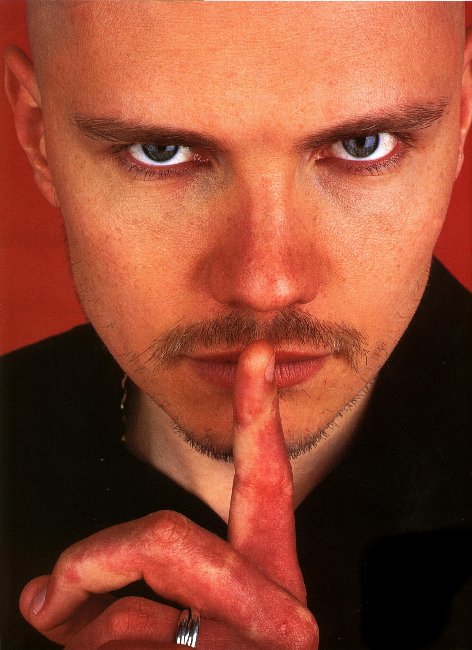
I was a diehard Smashing Pumpkins fan for about a seventh of my life, between the years 1998 and 2001. I got into the band after hearing a complete broadcast of the 1998 album Adore on Q101, "Chicago's Alternative," which I listened to religiously. My father got tickets to see the band perform on July 7, 1998, at what was then known as the New World Music Theater, in Tinley Park, Illinois. I loved the poetic impenetrability of Billy Corgan's lyrics, the soaring guitars, and, well, Billy Corgan: from the first time I saw the "Ava Adore" video on MTV, I was hooked on the bald songsmith's curious combination of vulnerability and theatricality. By the middle of eighth grade, I was madly in love: with his crooked teeth, with the birthmark that covered most of his left arm (as seen in seventh-grade me's favorite picture of him.) I wrote long poems to him in my journal. My greatest wish was to take a picture with Billy.

In my eighth grade yearbook, our answers to two questions were printed under our names beside our pictures: "If I could have one wish it would be..." and "In twenty years I will be..." My answers were "To be the inspiration for WPC's songs and JV's comics" and "Driving in a van with EG, listening to 1979." JV was Jhonen Vasquez, creator of Johnny the Homicidal Maniac, EG was my best friend Erin, and WPC was none other than William Patrick Corgan.

My love for the band waned after I attended their epic five-hour breakup concert; I'd put so much emotional energy into my fandom, waiting outside the XRT building in the November cold and getting my wallet stolen at a Tower Records signing for which I had convinced my parents to let me miss school. I didn't get into Zwan. I liked Corgan's 2005 solo album TheFutureEmbrace but not the way he undercut its release by taking out a giant ad in the Chicago Tribune calling the Pumpkins back together. Of course the reformed Pumpkins were just Billy and stalwart drummer Jimmy Chamberlain. His endless confessional blogging seemed to have destroyed any possibility of pulling James Iha and D'Arcy back into the whirlpool.

I imagine I'll write much more extensively about the Smashing Pumpkins (and Adore, the critically reviled album that remains my favorite) in this space. But the main reason for this entry is the new Watchmen trailer:


That's Billy's reedy voice there, singing "The Beginning is the End is the Beginning," the B-side to "The End is the Beginning is the End," which was written for and featured on the Batman and Robin soundtrack:


I'm sure this was the meta trick of some soundtrack scrub out in Silverlake, but all I hope for is that we get another greenscreen video with Billy in a unitard, gesticulating wildly.

Sunday, July 13, 2008

FYI

If a girl who describes herself as "bisexual-leaning-towards-lesbian" tells you you look like Starbuck, you should consider yourself hit-upon.

Tuesday, July 1, 2008

Something Brief About Radiohead


After my first boyfriend and I broke up, he got really into Radiohead. This was the April 2000, so he must have been listening to Kid A. It was the end of my freshman year of high school, and I had no experience with the band. Sometimes my ex and I would attempt to have amiable conversations outside the school while waiting for our parents to pick us up. He normally started off with some kind of backhanded compliment, such as "You're not dressed so slutty today."

And then he would start talking about Radiohead. Did I know, did I know, that Thom Yorke hated performing? That he performed with his back to the audience? Because all he cared about was the music? Did I know this?

No, of course not. I didn't listen to the band - although I did have a distinct memory of purchasing OK Computer in the seventh grade, hating it, and giving it to my mom - and I couldn't figure out what my ex was all worked up about. Later that year he wrote a bunch of poems with suspicously Radioheadesque titles: "Music (for the closing credits)," "IamnotwhoyouthinkIam," etc. And that was pretty much the last gulp of his engagement with popular culture before ascending into Grateful Dead cover band heaven, where he remains to this day.

Now, almost ten years later, Radiohead is a pretty undeniable cultural force. I went to see Radiohead in Milan on June 17. It was awesome. Thom Yorke did not, in fact, perform with his back to the audience. He danced like he was having a constant sexy seizure and stopped only to announce the football scores. And I wasn't dressed slutty, either.

Monday, June 30, 2008

Wanted: Pretty Great


I have a confession to make: I like seeing people get punched in the face. I’ve always kind of wanted to be in a fistfight. In my high school cafeteria I once witnessed a girl break a Snapple bottle in half and lunge with it at her opponent, also female. I don’t think anyone got hurt in that fight, but I saw another one before I graduated where a huge boy had bitten off piece of his tongue. A security guard picked the piece of tongue up off the floor and put it in his pocket.

But these aren’t the fights I fantasize about. I just want to get one good punch in and maybe spray a little blood on the wall. And I guess it would be okay if the same thing happened to me in the process. Perhaps this bloodlust is the reason why I deeply enjoyed Wanted, a movie admittedly plagued by some truly bad writing and unimaginative choices. The whole thing hit me like a roundhouse punch to the face, but in a good way: I felt jolted awake, even as I laughed with incredulity at some of the wooden dialogue.

Wanted suffers from several action movie clichés, including a mindless voiceover that nearly derailed the film for me – it doesn’t help that James McAvoy’s American accent sounds painfully singsongy, like a smart-alecky British kid making fun of the Yanks with lines like “I am the perfect weapon” spoken in a dead-serious drawl. I was aksi put off by Janice, McAvoy’s emasculating boss. Interesting things could have been done with this character – she could have been an attractive woman (maybe Angeline Jolie should have had this role) or a man, but instead the writers were lazy and made her an easy target: an overweight middle-aged woman. Janice is a foregone conclusion as soon as you see her: of course she’s awful, of course she’s an object of ridicule, because she’s fat! And not young! Hilarious use of a generic foreign country is also present; the crowd at the Prague cineplex where I saw the movie tittered when McAvoy and Jolie go to “Moravia,” represented by a Prague tram station.

Despite these not-inconsequential problems, the film moves along at an often-hilarious breakneck pace with infectious enthusiasm. It’s like that one really emotionally stunted friend we all had when we were fifteen who was incredibly good at video games but could barely get a sentence out in conversation. He could be frustrating to hang out with, and you were out of luck if you had a crush on him, but it could be pretty awesome to watch him play video games for a few hours. The Chicago portrayed in the film, while a far cry from the actual neighborhoods I grew up around, has an internal logic and symmetry that is emotionally true to the city, and an especially fine use is made of the El.

Endnote: in their review of the film, the A.V. Club references "McAvoy's Bud Cort-with-sex appeal looks," which further propels my fear that James McAvoy may age a as Bud Cort has.

What does the future hold?

Saturday, February 16, 2008

No Homo Film Society #1: Step Up 2 The Streets

When I was four and five years old, I took classes at The Academy of Movement and Music, a Martha Graham-style art school for children. I had been enrolled there to take part in the complete curriculum of music, art and dance, but ballet immediately elbowed every other subject out my imagination. While I enjoyed making papier-mache hot air balloons in Art (we covered an inflated balloon with the wet papier-mache goo, let it harden, then popped the balloon and tied it to one of those green strawberry baskets with pipe cleaners) and playing the recorder in Music, Ballet was the only class for which I had to wear a special costume and act like I was all sorts of things that I was not: elegant, graceful, physically competent. I loved the ritual of putting on pink tights and a black leotard, of standing at the barre in a perfect line, admiring the symmetry in the mirror.

Unfortunately, I was terrible at ballet. I could not make my arms and legs do what the teacher wanted them to. I understood the idea behind the movements, but I could never keep my arm curve just so, and any attempt to memorize the different plies was an exercise in futility. So while my drawings were interesting and colorful and my recorder rendition of “Hot Cross Buns,” eventually led to a seven-year stint playing the flute, I was done with ballet by second grade. This didn’t mean that I gave up on dance, however; for years afterward I tried to muscle my way back into that privileged world of beautiful, solemn girls, tall and thin as Aspen trees, that flew across the stage. I took so many Beginning Modern for Adults classes that I could probably teach it myself at some unlucky community center. I studied African Dance at the Old Town School of Folk Music under a terrifying, tiny man who had stolen the hearts of all of the other students, who were thirty-something yuppies when I was seventeen. I Jazzercised.

Although by the time I was fourteen I had accepted that I wouldn’t be experiencing any stunning return to the world of dance, I found myself unable to watch dance without feeling sad, like something had been taken from me. If I had only had more stamina as a five-year-old, I told myself, I could have made it. I was young enough that the training might have worked. I was mad at myself, and my parents, for letting me quit so soon. Now I realize that the decision to put me on swim team was much more productive than letting me suffer through several years of crushingly sad mediocre dancing. But the bitterness I felt led to crying jags after movies like Center Stage, or even after Orchesis shows.

On Valentine’s Day, I saw a movie destined to break the mistiness that descends on me whenever a young woman is thrust into an environment in which she must prove her moves or go back to her terrible job/abusive family/boring high school. My discussion of this film will also be the inaugural entry in a new feature, No Homo Film Society.


“No Homo” is a phrase my male friends used in high school after indulging in some homoerotic activity. Example: A and B wake to realize they’ve spent the entire night semi-cuddling in a Barcalounger in A’s living room.
A, detangling himself from B’s sleep hug: Hey. Hey, B, wake up.
B: Wha?
A: No homo, man.
B: Oh, dude, totally.

Out of the mouths of babes, right? Anyway, in the grand tradition of our greatest unwitting Bush Administration allegory, 300,, here we go for Step Up 2 The Streets. When I first saw the trailer for this gem, my initial impression was “Wow, the first one did well enough to warrant a sequel?” While I didn’t see its parent film, I have a special place in my heart for films about those high schools where all of the students are nearing thirty. What could be more glaringly inessential, and therefore incredibly important, than the sequel to a B-movie about a supposedly “edgy” subculture, as portrayed and imagined by people almost two decades older than their inspiration? Like Juno, Step Up 2 The Streets - one of the most aggravating cases of “wordplay” in recent memory – may have its heart in the right place, but its brain is a coldly self-motivated machine hellbent on sucking up mouthbreathing teenagers’ hard earned MySpace money. Mildly troubled Baltimore dance phenom Andie (Briana Evigan) is given a dreaded ultimatum: attend an arts high school or move to Texas! When she chooses the lesser evil and takes an interest in the remarkably boring Chase Collins (Robert Hoffman, who apparently “enjoys meeting people who can dance well”), her street crew, the 410, a sort of flashmob-obsessed group of renegade newsies, drops her.


Step Up 2 makes remarkably straight-faced use of every stereotype it can get its hands on. Sexually threatening black male crew leader? Check, in the form of Tuck, the 410 pater familias who spends most of the film frozen in a 50 Cent glare. Somewhat shrimpy Shia LeBoeuf stand-in whose bouncy hair disguises amazing freestyle dance ability? Check, with the ambitiously named Adam G. Sevani, but you can call him Moose. How about an Asian immigrant with a hilarious accent and misunderstanding of incredibly simple colloquialisms? No need to come out of retirement, Gedde Watanabe, Mari Koda does a serviceable job mispronouncing “prank” as “plank.” There’s also a sassy Latina girl and stressed-out single mom. Indeed, only characters who aren’t tired types are the bland-a-thon leads, whose vanilla romance is only mildly more interesting because Hoffman appears about twenty years older than Evigan.

What’s he doing in high school? We wonder, but then the answer emerges in the most wonderful fashion with my favorite character, Blake Collins, as played by Will Kemp. Blake is supposedly Chase’s older brother, a retired ballet legend deadset on making the school a Fame-style performer machine. But any viewer worth his salt knows that Blake Collins is really just Evil Gay Sufjan Stevens. I couldn't find a picture of Kemp as Blake Collins, so here's a naked picture of him for kicks.

Here’s where the No Homo part comes in, I guess. Blake Collins is such an archetypical Evil Gay that he may as well have emerged fully formed from the Baron Harkonnen’s fantasy world. The Evil Gay, like the Magical Black Man, is a familiar character in Movieland. Unlike his brother the Noble Gay (Dumbledore!), the Evil Gay is probably not celibate, and often possesses the power to limit the hero’s success or at least fun-having. Some famous Evil Gays include Peter Lorre in The Maltese Falcon and, more recently, Cillian Murphy’s Scarecrow in Batman Begins (and maybe Cillian Murphy in Red Eye, for that matter). Kemp's conspicuous love that cannot speak its name is about as subtle as Mickey Rooney’s turn as Mr. Yunioshi. I wish I had brought a camcorder into the theater just so that I could post a clip or two of the simmering sexual tension between Chase and Blake Collins. Their under-the-radar onscreen bromance is about the only time when Step Up 2 rises above the level of, well, risible fluff. Kemp pronounces every line like he’s shaking a sick kitten off his arm into a pot of boiling water. I just wish he would burst into a chorus of “John Wayne Gacy, Jr.”

I wish that one of these immortal dumb teen dance movies would present a troubled teenager whose love for street dance was actually encouraged and honed by involvement with classical dance. Step Up 2 The Streets indulges in a near avant-garde level of idiocy, best exemplified in the scene when boring heroine Andie, newly squeezed into a white sundress, walks into a room. Her friend Missy (Danielle Polanco) squeals, “Damn, girl! You got titties!" Andie looks down at her chest, but there’s nothing there, despite the post on Evigan's IMDB message board by "oscarmau" entitled "HUGE RACK."

Saturday, September 22, 2007

It's Not The End Of The World Or Anything

Snooping around over at The Dizzies, I found myself entranced by Ed’s ”livebloggery” of Cormac McCarthy’s appearance on Oprah. McCarthy’s latest book, The Road, has received acclaim from sources as diverse as the big O and the Pulitzer Prize committee. It’s also right up my alley, as speculative fiction by masterful artistss is always special treat for me, a dyed-in-the-wool science fiction/fantasy dork. I loved Kazuo Ishiguro’s Never Let Me Go, and leapt at the chance to see Wong Kar-Wai’s 2046. So why haven’t I already filled up a Facebook profile with quotes from The Road, aside from the fairly repugnant quality of that idea?

Because I’m terrified of The Road, and not only because reading an excerpt of it forced me to learn the meaning of the word "catamite".The truth is that I have a very dysfunctional relationship with post-apocalyptic and dystopic fiction. I enjoy it – a lot – but it scares the crap out of me. As a child, I often dreamed of directing horror films, not because I particularly wanted to be a director, but because I thought that if I could see how scary movies were made, they might not frighten me so much (I also said that I wanted to be a nurse so that I could “hurt people,” but that’s a different story). When I was a toddler, my parents were great fans of the Hellraiser series, and often watched the films in our living room after putting me to bed. On these nights, without fail, I crept downstairs to peep out from behind the couch, saw something awful, and refused to sleep for weeks. For whatever reason, stories where the world ends, or has ended, are still a bit much for me. Today, with valid warnings of a real Ragnarok at every turn, I try to keep my mind calm by avoiding any unnecessary terror. This is not something I have always done. Here’s a list of apocalyptic media that scared me in the past and scares me now.


1. TERMINATOR 2: JUDGEMENT DAY
If I saw T2 in theatres, then I must have been seven at my first viewing. I find this hard to believe. I mean, as previously noted, my parents were certainly a little laissez faire about what they let me watch, and I loved them for it. But this movie? Arnold Swarzenegger looking like a leather daddy and acting like a real daddy to poor screwed up Edward Furlong, and then sacrificing himself for humankind? This movie terrified me not because it was psychotically violent and not because that nice black computer scientist had to kill himself, but because there was no happy ending. Everything was fucked. Cut to shot of highway at night.

2. ALAS, BABYLON
I read Pat Frank’s 1959 surviving-the-nuclear-holocaust tale in my eighth grade advanced English class, which was cryptically called “A.T.P. Humanities” and taught by one Arlene Jarzab, who ran marathons and drove a red convertible. Ms. Jarzab had nothing but faith in her students’ ability to understand books typically assigned to high schoolers, which was why I read The Grapes of Wrath in fifth grade, The Good Earth in sixth grade, The Crucible in seventh grade and wrote a paper about population control in India in eighth grade. Alas, Babylon isn’t exactly one of the great works of the Western canon, but it is cannily gripping. The Russians drop the bomb on America, forcing the inhabitants of a surviving Florida town to recreate society. Diabetics die from lack of insulin, “highwaymen” are summarily executed for theft, and racial integration takes place out of necessity. The book is supposed to show how society could survive even the worst of all possible fears – by the end the survivors are serving fresh-squeezed orange juice and eating delicious roasted pigeon, and the spinsterish bluestocking is married and has chubby babies – but all I can ever think about is the telegram a military man sends his brother with their secret code for disaster: “Alas, Babylon.”

3. ANTHEM
Ayn Rand’s 1938 “Careful what you wish for, Socialists” novella was also assigned to me in eighth grade by Ms. Jarzab. In a distant future, collectivism has sent humankind back to the dark ages (but now with Communism!) and rendered them unable to use singular pronouns, meaning that the titular hero Equality 7-2521 begins every sentence with “we.” Equality is smart, but his independent thinking gets him assigned to menial labor by the Council of Vocations. He rediscovers electricity and attempts to use it for the greater good, but is imprisoned and tortured. Meanwhile, he falls in love (also a no-no) with a farm laborer. They run away together and find a preserved house in the woods, where they take the names of Prometheus and Gaea from a book. Now that I think about it, Anthem didn’t scare me so much as it pissed me off, because as soon as the woman (Gaea, nee Liberty 5-3000) learns to use the word “I,” she just starts spouting earth-mothery dreck like “I love you” and “I want to have your children,” and I kind of preferred the before version where she was reaping wheat and doing strong communist lady stuff. Also, my eighth-grade reading list looks kind of hysterically anti-Communist on second glance.

4. THE GIVER
I wonder if there’s anyone my age who read The Giver and didn’t find themselves haunted by the book’s strange blend of dystopic fiction and soft-core philosophy. I can’t recall whether or not I read Lois Lowry’s novel in school or on my own, but it almost doesn’t matter. The Giver was a genuine pop culture phenomenon among fifth- and sixth-graders in the mid-1990s, and probably still is. I remember carrying the book down the halls of my middle school and noticing who else had it, and having hushed conversations with my few friends about how very, very sad the book is. As in Anthem (and that granddaddy of dystopias, Brave New World), one of the most disturbing elements of the novel is the destruction of the family, although the infant distribution center and “birthmothers” of The Giver are somehow creepier than the straight-up kibbutz-style Home of the Infants in the Rand book (especially the scene where Jonas’s little sister mentions that she’d like to be a birthmother, and her parents admonish her…shudder). Jonas, the deep-blue-eyed, sensitive-boy protragonist, was also extremely crush-worthy. Lowry’s deft handling of adolescent sexuality stuck with me for long enough that I wrote some Giver slash when I was thirteen. I mean, Jonas’s dream about bathing Fiona? Hot.

5. THE HANDMAID’S TALE
I read Margaret Atwood’s 1985 novel when I was 18, so I don’t know if it qualifies as a apocalyptic work that terrified me in childhood. It did, however, upset me more than pretty much anything I had ever read, and also established Atwood as one of my favorite authors. In my opinion The Handmaid’s Tale should be required reading for every high school junior, particularly the legions of girls ready to go wild who don’t understand what all the fuss about feminism is. The book’s funny, smart, angry narrator, Offred (quote my best friend Ben: “Offred was so fucking hot,”) explains in simple steps how Reagan-era America is destroyed by the violent religious right and transformed into the Republic of Gilead, where nuclear warfare has made fertile women a hot commodity. There as so many moments in the book that still disturb my sleep; the re-education center (really an old high school gym) where women are sent to become Handmaids, Offred’s realization that her husband must have killed their cat when they were trying to escape, the photograph of Offred’s daughter shown her by Serena Joy, and the miserable nightclub where Jezebels are kept. Atwood lights a tiny candle of hope with the epilogue, which implies that Gilead is long gone and has been replaced with churlish Inuit academics. I may demolish any respect my three readers have for me by noting that the first time I read the book, I failed to recognize its setting as Cambridge, Massachusetts. But after I figured it out, I sure couldn’t take the playful antics of those Harvard types lightly anymore. The Handmaid's Tale has been adapted into a film, play, opera, and radio play, none of which I've seen.

6. DEEP IMPACT
From my first blog, called “Madrant:”

5-16-98
Tonight, I went to see a movie which was the most moving, touching, beautifuk [sic], and horrifying film which I have ever seen. It was tragic, heartbreaking, suspenseful and humourous at times...and you know what? You Titanic freaks can all go stare at a wall, because Deep Impact KICKS ASS!
It's the story of how a comet predicted to hit earth changes the lives of so many people...eh, I no feel like explaining. But it made me cry..and if you knew me, you'd know that I NEVER cry in movies. You could show me a half-hour of children starving to death, and I'd think it was sad, but I wouldn't cry. Deep Impact Made me cry...so many valiant people...so few shelters...ARRRGGHH! Depression!
I will see Deep Impact over and over and over and over and over and over and over and over and over and over and over again for the rest of my life...it is beautiful. And it kicks Titanic in the ass. So, to all Titanic fans: To females, stop staring at your Leo posters, use a Biore pore strip and go see this movie. YOu can see another, more appropriately aged attractive male in it, Elijah Wood(*sigh*) and ogle him...to Males, stop staring so fixatedly at your pictures of Kate Winslet nude and get off your ass, wash your hair and go outside. That glare is the sun you haven't seen in so long. Now, go to a movie theatre and see Deep Impact. Trtue, there's no naked chicks, but depending on your taste, there is Tea Leoni. Gosee [sic] it anyway...
Tired and hungry. K'bye.


It's kind of like LOLINTERNET: OH HI I'M IN YOUR PAST MAKIN YOU EMBARASSED

7. The Book of Revelations, especially as seen in the X-Files episode “All Souls” originally aired April 26, 1998

Although both of my parents were fairly burnt out on religion after decades of Catholic school and guilt, they made a valiant effort to inculcate the faith in our home. They weren’t about to send us to St. Mary-of-the-Ruler-Whack, however, so my sister and I went to extracurricular “CCD” or “Catholic class” held on Wednesday nights. I was a nightmare to the nice ladies who volunteered to teach these classes; I mean, I didn’t even process until the end of high school that they probably weren’t paid for their hour of sanctimonious workbook exercises. The highlight of my extremely splotchy CCD career was definitely seventh grade, when we were given Bibles and told to read the thing front to back. Not only did this give me bragging rights in my borderline-agnostic social circle for the rest of time, it also exposed me to Revelations, in which a woman in the sky gives birth to a dragon who swallows the sun. In “All Souls,” Scully has another forty minutes of religious guilt when she and Mulder have to figure out what’s going on with a series of handicapped girls who have died while in foster care. The girls were born with six fingers, and if I remember correctly, Lucifer is coming for them – but God gets them first, orchestrating their deaths so that they can ascend to heaven? I think? What I remember most is Scully reading some Revelations description of angels as having six wings: two to shield their eyes, two to stand on, and two to fly with. Scary. Also terrifying: Sufjan Stevens’ Seven Swans, especially the title song. Religious terror was never so hot or cuddly.

What books and movies scared you when you were small? Did the end of the world seem foreboding to you, too?

Monday, September 17, 2007

Good Ideas, Poorly Executed

It’s just my luck that the first novel I read and the first movie I saw upon returning to New York this autumn have been massive disappointments, despite their seemingly engaging premises. Admittedly, I had higher hopes for Felicia Luna Lemus’s Like Son than I did for Julie Taymor’s cloying Beatles singalong Across The Universe. I first heard of Like Son via a feature interview in the April 12 Time Out New York. The novel follows the pilgrim’s process of Frank Cruz, nee Francisca, a Mexican-American trans man whose father dies, leaving him an Edward Weston photograph of Nahui Olin, a mysterious woman. The picture of Olin – a real-life member of the Mexican avant-garde movement in the 1920s and a fascinating figure in her own right – obsesses Frank over the course of a decade, during which he moves from Los Angeles to New York City, falls in love, and becomes a man. I’m fascinated by trans culture, particularly with the under-looked demographic of female-to-male transsexuals, and the Olin angle made the book even more attractive to me, because god knows I love forgotten female artists. Various other themes Like Son promised to examine included race, class, and 9/11.

The curious thing about Like Son is that it flatly does not discuss most of its supposed themes. Frank’s sexuality is only addressed when it can’t be avoided or ignored. Early on, he states that as a troubled teenager, “All I knew was that I was a boy and that being a boy felt safe and true and right” – a statement that almost directly treats his male identity as a salve for the sexual abuse he suffered as a child. It’s not that I wanted Frank to constantly justify his transsexuality, but it does seem odd how little attention the topic receives, especially in the context of Frank’s eight-year sexual relationship with his girlfriend Nathalie; they “fuck” constantly, and Nathalie wants a baby, but Lemus never addresses how all of this physical love takes place. In fact, Nathalie herself is another black hole of a character. The woman is a standard-issue indie sexpot, all messy beehive hairdo and chipped nail polish, the kind of dame who wears vintage silk cocktail dresses all the time (despite the fact that she’s apparently an office temp) and vacuums in the nude. May I suggest an industry-wide ban on these dreamy, weepy, skinny wet-dreams of the thick-framed-glasses set? These chicks have been popping up in literature like mushrooms in a dirty shower. But I digress.

Most of Like Son focuses on cutesy-for-cutesy’s sake vignettes from Nathalie and Frank’s domestic life. Nathalie is flaky and sensitive, with a tendency to run off to different states when she feels sad. Frank steals trees from the outer boroughs and replants them in Tompkins Square Park. They go to a movie at the East Village Cinemas and drink coffee from bodegas. Nahui Olin takes a backseat to this thrilling litany of fin-de-siecle New York life, emerging from time to time to enchant Frank for about an hour before he goes on to the next melodramatic thing, like getting an ill-advised tattoo before boarding a train in search of his runaway girlfriend. Most frustratingly, at the end of the book, nothing is resolved: Nahui’s picture gets put in the safe-deposit box, along with Frank’s past, which he has completely failed to explore. Like Son reads like YA author Francesca Lia Block – that progenitor of Weetzie Bat and anorexia glamour - for grownups. It would have thrilled me when I was thirteen and obsessed with anything that seemed new and different, but unfortunately now I’m just obsessed with finding novels that earn their page count.


I can't say that I thought Across The Universewas even a good idea for a movie. I’ve enjoyed Julie Taymor’s previous work, especially Titus, but a Beatles musical just seems like a terrible idea no matter who directs it. The band itself covered this territory satisfactorily during their career, and besides, what about that Cirque de Soleil thing? Mightn’t the latter be a better exploitation of the music in question than a zany Taymor-a-thon, especially considering that live performance would at least inject some energy into the proceedings? Alas, my entreaties seem to have fallen on deaf ears, because the showing I saw was packed at four in the afternoon. The film’s crimes are almost too diverse to list. Evan Rachel Wood and Jim Sturgess, as the story’s titular lovers (if you’ve seen the trailer, I doubt you need a plot summary, but here’s one anyway: “In a time of change, they loved”) have about as much chemistry as my seventh-grade self trying to light a Bunsen burner. They both behave in a peculiarly modern fashion – Wood, especially, seems more like her character from Thirteen than a hippie-turned-political activist, although probably less fun in the sack.

As The A.V. Club noted, by far the worst musical number is Eddie Izzard’s performance of “For the Benefit of Mr. Kite,” but equally excreable is anything that comes out of the lame mouths of Hendrix and Joplin rip-offs "Jojo" and "Sadie." Ultimately the film proves so frustrating, and so wildly inconsistent – why is there an Asian-American lesbian from the Midwest in the mix? Why can’t the movie make up its mind where it cares about the civil rights movement or not? Why does Vietnam look suspiciously like a museum diorama about war? – that the true sweetness of certain of its moments its completely obliterated (anachronism or nor, T.V. Carpio’s performance of “I Want To Hold Your Hand” is lovely). Weirdest of all, Across the Universe presents a Sixties America where free love and radical politics don’t deadend into the interesting, fucked-up seventies, but blossom into an endless hugfest. In a world where the Beatles are endlessly abused but never even mentioned by name, that’s a tough pill to swallow.