Showing posts with label geekery. Show all posts

Wednesday, September 9, 2009

Menstrual blood, dandruff, garlic, Stella McCartney perfume, and shampoo, I'd wager

I was listening to some lovely songs on Orenda Fink's MySpace when, I shit you not, this advertisement popped up:


It'd be easy to join the bandwagon of Twilight hatred, but I'm not going to. I'll level with you guys. I think Twilight is pretty awesome. I'm no fan of the retrograde gender/sex politics of the series - although, having read none of the books and seen only the first movie, I don't really know that I'm qualified to comment; I'm just following the lead of other writers I admire and respect - but I can't help a deep intrinsic affinity for Twilight and its fans, the titular Twihards. I've always adored vampires, to the point where I enjoy pretty much any pop culture product that involves them, even if, as with True Blood, I often wish it were better than it actually is. Frankly, Twilight as a delivery service of sexual tension and questions to preteen girls - even if it does go on to answer those questions with the bludgeon of abstinence - doesn't seem like an overwhelmingly negative thing to me. Especially if it leads them to the work of other vampire writers, like the ones I enjoyed as a preteen, Poppy Z. Brite foremost among them. Although Brite has since moved onto excellent culinary fiction (and seems to be taking a sabbatical from writing in the wake of Hurricane Katrina), her splatterpunk vamp novels Lost Souls and Drawing Blood were my bread and butter in the late 90s and early 00s.

I will revisit Brite's work at length in this space, but I'll close here by saying that Stephenie Meyer is damn lucky that so much deeply sexual vampire literature has laid the groundwork for her truly chaste vamp fable. We want Edward because we know he'd be killer in bed if we could just get him there.

Tuesday, September 8, 2009

The Racial Politics of District 9


Warning: Definite spoilers ahead.

As I watched Winkus Van De Merwe, the titular anti-hero of Neil Blomkamp's feature District 9, grow a conscience along with his new "Prawn" body parts, I couldn't help wondering how the film would have been received if the Other in the film had been brown people instead of large insectile aliens. Winkus's character arc is familiar from well-intentioned old-fashioned narratives where the interloping white man infiltrates an othered culture, either of purpose or by accident, comes to understand the gentle natives and eventually turns tail on his own kind to help them escape their oppressors. It's an old story, the White Man's Burden, one where only the outsider can appropriately organize the pure-hearted but disorganized othered mass and lead them to freedom.

I don't think a full indictment of Blomkamp's movie is in order - it's a fresh take on the science fiction epic, and compellingly explores several themes that are ripe for inclusion in pop culture discourse, foremost among them the issue of displaced and refugee communities. Still, setting the film in Johannesburg and involving another refugee population - that of the Nigerians who also live in the slums and scam the alien population - gave Blomkamp the opportunity to make a more considered inquiry into the issues of race and culture present in his fictional situation. I can't say I was too impressed with the garden-variety witchdoctor-employing African warlord Obesandjo, who had the capacity to be expanded into a pivotal player but remained a stereotype of a ca-razy African primitive. Also of interest / frustrating: the fact that military contractors have joined the ranks of Nazis and, well, giant insectile aliens in that rarified class of villains who can be killed with impunity. And I have to agree with Rich at Fourfour's complaint about the film's inexplicable switch from straightforward fake-documentary to first-person narrative film.

Still, I enjoyed District 9 and found myself moved by most of its emotional tricks: the kind and humane alien, Christopher Johnson, and his paternal relationship with his son, as well as Winkus's enduring love for his wife Tanya. It's also one of the most uncannily unsettling movies I've seen in a long time, making the most of its odd marriage of faux-documentary style to the constant threat of Cronenberg-level body violence. The film's greatest strength is Winkus himself, a weird Michael Scott of alien management who we manage to root both for and against. I will be interested to see the sequel, currently known as District 10, and see how much further Blomkamp can take his allegory.

Miscellany.

* I have a website now! Check it out: www.lisalocascio.com

* My story "Park Rats" was featured on Joyland Chicago

* My food writing appeared on One For The Table. Check out the short essays: "Fried Fish" and Cafe Orlin.

Saturday, April 18, 2009

Like light


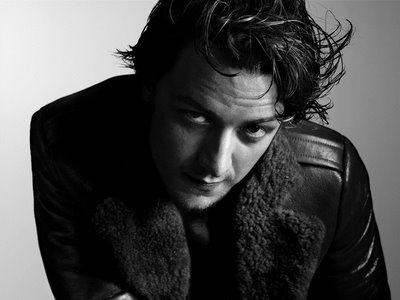
Do you know how many photographs of James McAvoy I have on my computer?


So many.


When, as a senior in high school, I developed a terrible crush on Adrien Brody, I tortured myself with the knowledge that it was completely inappropriate because I was so old. Even as I bought an autographed photo of Brody on eBay and cut pictures of him out of magazines, tried to follow his supremely boring lovelife on the internet and traveled alone to a movie theater about forty-five minutes away from my house on the El to watch the middling pre-Brody-Oscar streetlife movie Love The Hard Way, I felt guilty. I was eighteen! I was way too old to, you know, discover that Brody's mother was acclaimed photog Sylvia Plachy, buy a bunch of her hardcover collections on Amazon, and try and cultivate a correspondence with Plachy about how much I enjoyed her work so that we would be best friends when I moved to New York for college and I would become her protegee and she would introduce me to her charming, single son...

You see the way my mind works. But I was eighteen. I was still allowed a little bit of that. Being a senior in high school with a crush on a translucent-nosed Oscar-winner was way more okay than being a first-year master's candidate BitTorrenting British TV like State of Play and Shameless just so I could take screenshots like this one:


It's fitting that I have yet to see The Last King of Scotland, one of McAvoy's more famous efforts, but I have sat through all of the Children of Dune miniseries (what an intersection, my favorite pale Scot playing my favorite post-human Messiah's son!) and the aforementioned "middling James McAvoy vehicle" Starter For 10. Oh man, I should definitely see Rory O'Shea Was Here, the fun-quadripalegic movie whose more restrained UK title was Inside I'm Dancing. That looks right up my alley.

Also, I saw Wanted in a movie theatre in the Czech Republic. Twice.

Why the outpouring of sudden McAvoy love, aside from my inescapable preoccupation with this scene from Atonement?


(Not original, I know. But understandable.)


The Guardian has a Proust Questionnaire-like Q&A with McAvoy up on their website, and honestly, the whole thing is just a bit much for me to bear. I just got out of this crush, McAvoy. Don't drag me back in.

My favorite of his responses:

When were you happiest?
When I was 15 or 16 - I slept really well then. Now I sleep on a bed of anxiety-tipped nails.

What is your most treasured possession?
My lightsaber - it's well cool.

What do you most dislike about your appearance?
Freckles.

What would be your fancy dress costume of choice?
Boomer or Athena from Battlestar Galactica.

If you could go back in time, where would you go?
To when dragons roamed the Earth.

What does love feel like?
Like light.


Be still, my heart.

Sunday, April 12, 2009

Pacific Rimjob

I recently received the happy news that I will be moving to Los Angeles, a city I have long admired from afar, this fall to begin a doctoral program. With that in mind, I thought I'd set out on a free-associative sprawl through a culture I'll be somewhat nearer to starting this September: Japan!

What was my first impression of Japanese culture? My parents started feeding me sushi when I was fairly young...


(Note: Not a picture of me)


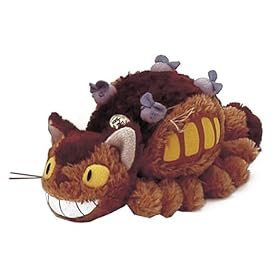
Around the time I was ten, my mom became aware of Hayao Miyazaki's 1988 masterpiece My Neighbor Totoro. She sent away for a VHS copy, which my sister and I watched with glee.


For years we searched high and low for Totoro merchandise, not easy to find in mid-1990s suburban Chicago. When I visited the Sawtelle neighborhood of LA with my boyfriend many years later, I was blissed out of my mind to find a stuffed Catbus at the Giant Robot store.


On a childhood vacation to Disney World, I discovered Yukito Kushiro's Battle Angel Alita, a manga about a lonely cyborg girl with a mysterious past. I never fell fully into real manga or anime fandom, although I enjoyed plenty of both media.


I also remember being taken to a Japanese restaurant in Chicago called Suntory at some point in my childhood. It served what I would later come to recognize as shabu-shabu cuisine. The waitresses wore full kimono. I very clearly recall that the restaurant displayed photographs of its locations all over the world - including outposts in Sydney and Johannesburg - and yet I strangely cannot find any evidence of its existence on the internet.

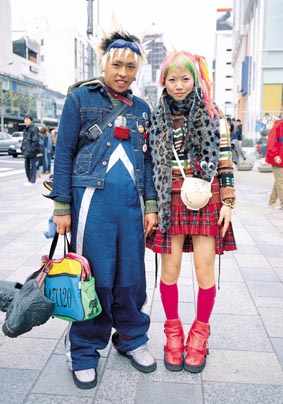
At the beginning of adolescence, I became, like most teenage girls who like Hot Topic, enthralled by FRUITS, the bombastic collection of photographs of Tokyo street fashion available in book and postcard form:


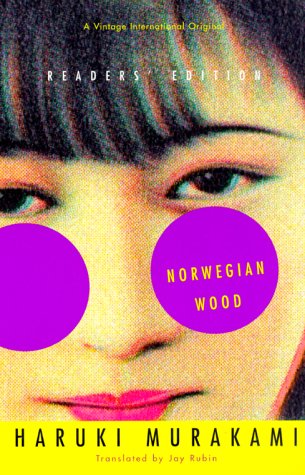
During high school I discovered the work of Haruki Murakami, America's favorite Japanese surrealist. Norwegian Wood was my first Murakami book.


I tried, and failed, to custom-order a white kimono to wear to my high school graduation. In college I read Edward Said's Orientalism, which made me feel a little bad about my love of Japanese weirdness. But I also experienced the work of great Japanese filmmakers in depth. I took a course at Facets Cinematheque on the work of genius / idiot savant provacateur Takashi Miike, director perhaps most famously of Audition:


I've also long nurtured a frustrated desire to learn more about the Ainu, Japan's aboriginal people. Two years ago I was lucky to see Tomu Uchida's film about Ainu culture, The Outsiders at BAM. I've still got my fingers crossed for a Criterion release.


I decided to make this post because my roommate and I were discussing ZZ Packer's short story "Geese," a masterful treatment of the outsider experience of Japanese culture. The juxtaposition of the African-American and Japanese cultural experiences reminded me of my new favorite thing about Japan: Jero!


Jero is the stage name of Jerome Charles White, a Pittsburg native who is now a star in Japan. Jero's maternal grandmother is Japanese, and he grew up listening to enka music with her. Enka is a tradition of very heavily sentimental love songs which has recently gone out of style in Japan. For an English equivalent, think of the work of Perry Como, the "Velvet Fog." (With Japanese subtitles for thematic consistency!)


I'll leave you with this CNN interview with Jero. Sayonara!


Friday, February 6, 2009

Two Movies

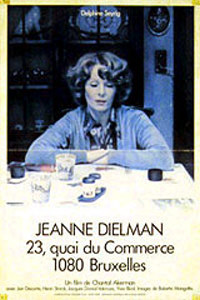
Last week, after what I think was exactly a calendar year of not going to the Film Forum for no other reason than sheer laziness (well, also not living in NYC for five months of 2008), I saw two films at the Film Forum. They were Silent Light, directed by Carlos Reygadas, and Jeanne Dielman, 23 Quai du Commerce, 1080 Bruxelles, directed by Chantal Akerman. It was my first time seeing both movies.


The premise of Silent Light (Stellet Licht in Plattdeutsch, the language spoken by Russian Mennonites) - a man falls in love with a woman who is not his wife - interested me less than the details of its production. Silent Light was filmed with a nonprofessional cast of Mennonite actors. Although it takes place in the Mennonite community in north Mexico (a community I did not know existed), the actors also hail from Canada and Germany, and were able to communicate with eachother because they all speak the same small language. Miriam Toews, one of the lead actors, is an acclaimed Canadian author who was raised in a Mennonite community. All of this is the type of trivia that makes me adore movies.

And I did enjoy Silent Light deeply, although my prurient interest in the film as a window into the cloistered lives of Mexican Mennonites ended up being inconsequential. The movie is an explosion of sensuality. Watching Silent Light reminded me of an African cinema course I took during my undergraduate career. The instructor told us that we would have to learn to read film in a new way, since African cinema features few of the tropes of mainstream American movies (closeups, quick cuts, flashy camerawork) and often features long still shots on people moving through a landscape. But Reygadas's film is by no means plain. every scene was so full of texture that I felt physically respondent to the film, wet when it was raining, heavy with sorrow during scenes of a funeral - but it subverts the expectations of the modern viewer. The film begins and ends with long dreamlike shots of a sunrise and sunset. The images are strikingly beautiful, and yet the desire to look away, to do something other than focus on what was in front of me, was hard to resist. Most of the people in the theatre did not resist - the rows were lit up with cell-phone screens as people texted and checked their missed calls. But Silent Light is all about the value of experience, even at the cost of personal comfort. A life fully lived, it seems to say, will never run out of surprises.


Jeanne Dielman is completely tonally different from Silent Light, but it too has a deep love for the unmoving camera. For nearly three and a half hours the viewer follows Jeanne through her day. She is a Belgian housewife without a husband, performing the rituals of domesticity seemingly solely for the benefit of her teenage son, who is at school all day. Even with the promise of "something" happening at the end of the movie, Jeanne Dielman is a long haul. Scenes ten and fifteen minutes long show Jeanne meticulously preparing food and then cleaning up after herself with a heartbreaking efficiency. The viewer returns with Jeanne to her chores - folding up the sofa bed her son sleeps on, making her own bed, grinding coffee beans - so many times that one starts to feel the same sense of exhaustion and misery at the routine that Jeanne herself must feel.


One of Jeanne's daily tasks is draping a small towel over her shiny middle-class bedspread, so that the gentleman caller she receives in the middle of each day will not sully her linens. Jeanne Dielman is a genteel prostitute, you see, selling dispassionate rolls in the sack in exchange for her continued stasis. These encounters are barely shown in the movie. Instead, we see Jeanne's ability to cope deteriorate over the course of the three days. On the second day, her hair is still tousled when her son gets home. "Your hair's a mess," he says, scarfing down his food. Jeanne's sister writes to her from Canada: would you like to visit us and maybe meet a nice man? But Jeanne can't even summon the energy to decide whether or not she would like to make the trip.

Where Silent Light was life-affirming for me, Jeanne Dielman felt uncomfortably familiar. I, too, am a woman who spends a lot of time alone in her apartment, although I am not also a discreet prostitute. I know the feeling of preparing a meal for yourself and then carefully cleaning up all evidence that the meal even occurred. The slight satisfaction that I take from small household tasks can become an enormous gloominess over the course of a day spent alone. By nightfall I'm restless, and if there's nothing for me to do and no one to see, the clean kitchen is small comfort.

Chantal Akerman was 25 when she made Jeanne Dielman. In an interview with my friend Dennis Lim, Akerman said:
“Jeanne has to organize her life, to not have any space, any time, so she won’t be depressed or anxious. She didn’t want to have one free hour because she didn’t know how to fill that hour. [...] I sometimes think I should have made it after many other films, at the end of my career,” she said. “I remember saying to myself, how can I make a better film? But it was also exactly the film I had to make then. It says something about a woman, about a way of living a life, about life after the war. It was the first thing I had to pour out of myself.”

She added, “I would have changed nothing about it.”

Thursday, January 15, 2009

The Cutest Animal You've Never Heard Of

The Pika!

In Memoriam: Patrick McGoohan

I'm not sure where I first heard of the remarkable television show The Prisoner. Like other cult television shows (Twin Peaks being the most obvious example), The Prisoner had an extremely brief run, from October 1967 to February 1968, but has come to loom large in the pop culture imagination. Maybe I was familiar with the concept from the Simpsons episode "The Computer Wore Menace Shoes," a terrific Prisoner parody of which no YouTube clip seems to exist, sadly. In any case, I received the complete series DVD set for Christmas 2004 and watched it in its entirety over the next six months.

It was a happy time in my life. I was a sophomore in college, living in a tiny Lower East Side apartment with my boyfriend and my best friend. The apartment was advertised as a two-bedroom, but was in fact a one-bedroom. My boyfriend and I slept in what was meant to be the living room, which featured the only two windows that let in natural light (the rest looked out on airshafts). Our futon was pressed up against the windows, and it was freezing in the winter. My mild domestic impulses seemed like hysteria in contrast to the laissez-faire housekeeping of my roommates, who left snail trails of library books and sweaters in their wake as they moved through the three rooms. The bathroom was coated in tiny curly black hairs and the kitchen was almost always dirty. I had never been so happy in my entire life.

During our frequent breaks from reading Orientalism and writing about the fluidity of gender roles my boyfriend and I would sit down and watch an episode or three of The Prisoner. What joy the opening sequence always brought us:


And what happiness to hear the series' star, Patrick McGoohan, intone some of his immortal phrases. Our particular favorite was his send-off, "Be seeing you," of which my boyfriend could do a killer impersonation. More than forty years after the show was on the air, he and I had become rabid Prisoner fans. The series is terribly smart, engaging and challenging a variety ideologies. Even in its missteps - there's an entire Western-themed episode, which didn't work for me - it never condescends to the viewer. Plus, it features a villainous weather balloon.

The news that the show's star, ice-cold badass Patrick McGoohan, died yesterday at age 80 filled me with a sadness I can attribute to more than my hatred of the freezing weather. On The Prisoner he rode the line between camp and cool like it was a British sports car or a crazy-ass bicycle. Rest in peace, Number Six. Be seeing you.

Sunday, January 11, 2009

Ruminations on the Golden Globes

I have always had only the most passing interest in the Golden Globes. In keeping with that lack of enthusiasm, here is an incomplete, vaguely stream-of-consciousness liveblog of tonight's show.

7:47 pm: They just showed Marisa Tomei. I feel like every time I've heard her name mentioned in the past five years has been in reference to how surprisingly good she looks naked. In 2005, someone mentioned this in relation to her role in Factotum. But by far the most constant comment about Tomei is that she "looks amazing" in Before The Devil Knows You're Dead. Seriously, upwards of sixteen men have mentioned this to me. Good for Tomei. I bet this skill comes in handy in her current role as a stripper in The Wrestler (Full disclosure: I have not seen any of the films mentioned above).

7:57 pm: "Please welcome the star of the upcoming films Bunraku and Happy Tears, Demi Moore!" Best sentence ever? Also, I misheard "Bunraku" as "Spunkaroo."

8:01 pm: My mom just said "There's Shirley MacLaine! She's still alive!"

8:09 pm: This announcer has not been given a lot to work with: "Here are two stars of The Dark Knight, Maggie Gyllenhaal and Aaron Eckhart!" Here they are, folks! Two of 'em!

8:12 pm: Laura Linney has the most beautiful skin. What does she do? Bathe in the blood of virgins, Erzsebet Batory-style?

8:22 pm: Alec Baldwin looked adorably nervous when they announced his nomination. Also, what did David Duchovny mouth to the camera? He told me what he was going to say this morning before he left my apartment, but I forgot.

8:30 pm: Renee Zellweger's dress is hideous! This makes me happy! Also, they just cut very briefly to an incredibly creepy shot of Marc Anthony stroking Jennifer Lopez's arm.

8:44 pm: Hi, Kate Beckinsale! You and Diddy are a hilariously wooden duo. Remember when you had a career and made good movies? I don't!

Sometime later - didn't record the time: David Duchovny was so sad in front of the mike with Jane Krakowski, I can't even make a good joke about his sex addiction and how it has impacted me in a positive way.

9:18 pm: Sandra Bullock making a tired joke about the relative sexiness of the Vicky Cristina Barcelona setup is my idea of the entertainment in hell.

9:29 pm: Do the people in attendance really care enough about Madonna and Guy Ritchie's divorce to look mildly scandalized at Sasha Baron Cohen's mild joke?

9:38 pm: As Kate Winslet wins her second Globe of the evening, my committment to this project waffles. Amelie Gilette is way better at this than me: "9:20pm--Slumdog Millionaire, the only movie that could make Who Wants To Be A Millionaire even remotely entertaining, wins for best screenplay. Brad Pitt clearly mouthed, "What's this for?" as the writer went up on stage. If it's not a magical 80-year-old in love with an 11-year-old , it doesn't matter does it, Brad?"

9:43 pm: "Hello, we're TV actors." Pretty good, Rainn Wilson.

Tuesday, December 16, 2008

Masters, Legends


In the current Rolling Stone, there's an article (not online yet) about Orlando-based real life superhero Master Legend. ML is one of what the article calls "a growing network of similarly homespun caped crusaders emerg[ing] across the country," a tiny group of men and women who, taking inspiration from Golden- and Silver-Age comic books, dress up in bright colors to fight evildoers. I am not intimately familiar with this movement, despite being a devoted comics reader, but I feel that the article does these guys a disservice. Author Joshuah (nice spelling, bro) Bearman takes the easy way out, writing the profile in a tone that vacillates between mild derision and charmed amusement. According to Bearman, it's nice that these losers want to help people, but not terribly effective. Master Legend and both of his sidekicks - the Ace, and then his replacement Ace Gauge - are given the usual "fun weirdo" treatment. The article takes it as a given that their do-gooding is cute but ultimately useless, the machinations of men rendered impotent by poverty, abuse, and casual alcoholism.

I found the article's condescending tone tiresome, particularly the following passage:
Real Life Superheroes have a conflicted relationship with law enforcement. The hardcore types have a somewhat dated, Death Wish-era worldview, as if the cities are overrun by chain-saw-wielding clown gangs and the cops just can't control the streets anymore. The more civic-minded superheroes imagine themselves as informal police adjuncts, a secret society of costumed McGruffs. One of Master Legend's most prized possessions is a framed certificate of commendation from the Orange County Sheriff's Department, for the time he and the Disabler snapped into action after Hurricane Charley, helping to clear the roads and rescue people from the wreckage. "We were on the news and everything," Master Legend says. "The police recognized everything we did."

Since then, Master Legend claims that he has developed a police contact on the inside, his "very own Comissioner Gordon." To prove it, he gives me a phone number. I immediately call and leave a message; I've tried to confirm tales from other superheroes, only to discover that the police have never heard of them.

"I have friends in high places," Master Legend promises. "When they see the silver and black, they know who's coming."

As it turns out, Master Legend's police contact later gets in touch with Bearman and confirms that ML has been helpful to him. I just don't think ML, gentle and slightly deluded dork that he might be, deserves the condescension RS heaps on him. His tasks - protecting endangered gopher tortoises, handing out toiletries and clothing to the homeless during a staph infection epidemic, and the aforementioned hurricane relief work - are pretty fucking honorable. Bearman never gets over the hilarity of the fact that ML and his cohorts take their task so seriously. Little jabs sprinkled throughout the text ( "This whole movement is more than just fat guys in spandex," insists Superhero, himself a brawny guy in head-to-toe spandex, yuk yuk) function as winks to the reader: don't worry, we don't think this stuff is any more valid than you do.

But aside from the general DIY lameness of the Real Life Superhero endeavor, I'm not sure these people deserve our ire. Certainly Master Legend and his ilk are illustrative of how incredibly less cool comics are when brought to life - the whole thing is kind of like a community theatre production of Watchmen Live! - but isn't that kind of awesome, too?

I've often been told - mainly by my male friends - that I'm not a real comic book fan because my life as a comics reader began with a grab-bag of EC Comics, Archie comics, and the aforementioned influx of Slave Labor Graphics titles.

(Cut to 13-year-old me, in the SLG IRC chatroom, talking to Lenore author Roman Dirge: Hi! I found out about Lenore the way most people do...
Roman Dirge: Oh? How's that?
Me: From reading JTHM!!!
Roman Dirge: Great.)

And it's true, I didn't grow up obsessively following most of the standard superhero characters, although I did read long runs of Spiderman and Uncanny X-Men, and collected X-Men trading cards. But I loved and love comic books for their unlimited potential. For me, words and pictures aren't about the possibility of super powers, they're about possibility, period; about the potential for everything from familial reconciliation through literature to out-Lynching David Lynch.

Thursday, December 11, 2008

On my knees for Nny

In January 1998 I was in seventh grade. Shortly after winter break, I came down with a terrible cold, the type of mucousy weeks-long ordeal that everyone falls into time and again, but I took it very personally. The previous summer, I had begun keeping a journal. One of the first entries, on June 6, 1997, read: "I got my period. A week ago. Not that it matters, anyway." The following entry was on the same page:
I have a new motto. IF YOU DON'T LIKE ME, SCREW YOU. And you know what? It works pretty well!

Seventh grade was marginally better than sixth, the hands-down winner of Worst School Year Ever, mainly because the universe took pity on me and moved a new girl into my suburb. I spotted her on the first day of school and zeroed right in, transfixed by the possibility that I might be able to nab her before she figured out how lame I was. On the first day of school I had a newly dyed-red bob and a cool black sweater with rainbow stripes across the chest. Executing a version of the awesome "sexy walk" I'd been working on, I hobbled over to her desk. "Hi," I said. "Are you new?"

That dear sweet girl later said that she looked up to see me "half-limping, half-humping" my way down the aisle towards her. And she forgave me that, as well as an endless list of other ills: the way, in ninth grade, that I zipped hoodies up to just under my rack and actually pushed the sweatshirt back behind my boobs, my raver-baby-goth vinyl nightmare wardrobe from 1999-2001, a habit of casual lying so strong that I once told her my dog was purple and held to it as the (white) dog walked into the room.

One of the reasons my cold pissed me off so much was because it necessarily postponed my first sleepover with my new friend. The catarrh I'd contracted managed to destroy any positive element of January, the most miserable month of the year. I holed up in my room with my favorite comic books, Jhonen Vasquez's Johnny The Homicidal Maniac series, and their natural soundtrack, the first Garbage album.


My father had brought me a few issues of Johnny The Homicidal Maniac (hereafter JTHM) the previous fall. By the middle of the winter I was hooked, having read and reread them until the bindings were wobbly. I was missing a few of the seven issues - #4 and #6, I think - but the storyline was comprehensible without them. The main character, who abbreviates Johnny to "Nny," is a psychotic shut-in with awesome boots who murders people in creative ways to generate a continuous supply of blood with which to cover a wall. If the wall doesn't stay covered in blood, "things" begin to push through from the other side. Nny is surrounded by a menagerie of goths, unhappy children, and inanimate objects - dead rabbits, sinister doughboys - who embody different elements of his internal monologue.

JTHM is a major pop culture lodestar for millennial goths, but I didn't know that when I started reading it. It was just something my dad brought back from the comic book store, and it aligned nicely with my nihilistic thirteen-year-old worldview. What I liked about JTHM and Marilyn Manson then is the same thing I now like about Crystal Castles: extreme violence transcendent in its exaggeration. I've never lost my appetite for media willing to grab my face and force me into something, even while I've maintained a simpatico for gentler music, literature, and film (see Sufjan Stevens, the work of Marilynne Robinson, Benny and Joon).

So I holed up in my room with the comics and the album, playing the song "My Lover's Box," over and over again. I was confused by the way I felt for Nny: deep sympathy, almost pity, a desire to take care of him (relationship problems here I come!). I knew, of course, that he wasn't real. For my purposes, however, he was about as accessible as the boys I had given up having crushes on at school and the whiny lead singer of my favorite band.

I decided to start a new website to suss out my feelings. I had played webmistress once before, in the winter of sixth grade, with an Angelfire page called "Faeri's Place" that featured a pretty boilerplate poem about the effects of social ostracization (not good). This time I drafted up a website using Geocities called "My Own Personal Dungeon: A Tribute to Nny." This website still exists. Here's a sample:
My opening spiel: The first time I picked up a JTHM, I was 13, fed up with life and utterly convinced that I was not only alone in my opinions and views, but that I would always be. Once I read JTHM #1, my entire perspective changed. I suddenly loved everything that Nny said and stood for and meant(as sick as it was). I didn't really care about the fact that he had caverns below his home filled with corpses--he had the same type of pain I did, the kind I was convinced that no one else could have. Unfortuantely, I somehow misplaced my JTHM #3-6, so all I have now are #s 1,2, and 7( and couple of equally delightful Squees). I never even got a chance to read the ones I lost, so I'm looking forward to buying the Trade Paperback Which I now have.

One major thing that clouds my life is my hatred for my school and the brats who attend it. They can't see that my differences, my individuality, make me a more interesting person, not a worse one. When I am done with middle school, when I go to high school and am liberated because my friends and I will have a place and actually make sense, I will look back on this and smile. But for now I frown.

From a page called "Learn more about MEEEEE!!": My interests include art, sculpture, books, and making teachers cry. One thing I really love to do is wear little black dresses and capes to dances and baffle the little sunny girls in pink while I dance with all the hot boys. That's fun. But anyway, I like a lot of music...some of its good and some of tis bad.. Most notably, Fiona Apple, Tori Amos, Emma Townshend, Veruca Salt, NIN, Sneaker Pimps, Eve 6, Green Day, Beck, and Everclear. Scuba diving is fun and I love the British Vrigin Islands. I worship his holiness Jhonen Vasquez. No, really, I;'m a wiccan, but I don't want to explain that right now. Maybe I;ll do it later. Anyway, here is the maor proof that I am on the right side of the thin line between genius and insanity(but what is the right side?):

I have a crush on Nny.

Yes. Its true. I'm not one of those freaks who ends up on the Jerry Spring show who likes criminals. I would rather that Nny did not kill people. But that doesn'y cloud my liking of him. The things he says are wonderful and beautiful. He makes so much sense with his wisdom:

"How is it you're so beautiful and so fucking ugly on the inside?"

"It's like every time I leave my house I give up my right to being treated like a person."

Sigghhhhh. Welll, I know I'm scaring you. I'm scaring myself. I hope I'm scaring the Christian Fundimentalists. Peace and out. Look at the rest of the sight.


All [sic], obviously. I must really trust the internet to unearth and repost this material here. Of course lot of the above was made up; dreamed of it though I may have, I never wore capes to school dances, and I don't know how to scuba dive. Thankfully, I was one of the more internet-savvy kids at my school; if anyone with an uncharitable soul had found this website, seventh and eighth grade might have been serious competitors for sixth grade's Worst Ever crown.

I was a silly kid who wanted bigger and darker things in my wonderful sheltered life. I had a bottle of nail polish, black with sparkles in it, called "Out All Night."

"Oh yeah, that sounds just like you," my new best friend said when I brought it over to her house for our sleepover the next weekend.

Tuesday, December 9, 2008

This blog is only about vampires and personal ads

Most vampire stories are love stories, and any good love story has an element of impossibility. Vampire love is either the most or the least impossible, depending on how you look at it. The solution to falling in love with a vamp seems obvious. Undead bites living, and the two are together forever. But it's never that easy.

One would think that vampires would avoid all the attendant trouble of falling for their food, and stick instead to their own kind, as they are often hissingly encouraged to do in by old flames. Yet nearly every story of bloodsucking passion includes the weak logic that vampires, left alone with each other for eternity, are largely sick of each other. The exception is the evil pod of vampires that stalks through every story with a sympathetic vamp - an odd number, maybe five or three, often featuring only one woman, with the dark implication of an even more perverse sexuality, as if part of the dark arts are endless "Heavy Duty dicks for One Lucky Chick".


One of the marks of a "good" vampire is inexorable attraction to - and fated love for - a specific human. Dracula had Mina, and now in the film adaptation of Stephanie Meyer's incredibly successful Twilight series, Edward Cullen has Bella Swan. I've never read the Meyer books, but that's mostly because the first one was published long after my departure from the YA aisle at the bookstore. If I was eleven, I'd be all over this shit. The last few weeks have seen a hemorrhage of vampire media. I've seen both Twilight and Let The Right One In, a far superior Swedish film with a similar topic. I also finished the season of True Blood, a bit behind the rest of the American public.

In all of these stories, a vampire's mettle is tested by their desire for their human love, bloodlust and regular-lust conflated by proximity. True Blood's Bill Compton thinks he can control himself, and generally does, but neither Edward Cullen nor Eli, Let The Right One In's preteen vamp and the only girl of the trio, has such faith in the strength of their wills. Ultimately each of these narratives are about the concept of self-control, a neat trick especially for Twilight's convenient abstinence corollary. Of the three, Let The Right One In succeeds most fully, becoming the story of a friendship just a bit stranger than usual without resorting to the romance-novel histrionics of Twilight or self-satisfied TV tropes of True Blood.

What was the first vampire movie I ever saw? My father was a fan of Dark Shadows, so we followed the 1991 remake. I also have a hazy memory of a night spent watching one of the Christopher Lee Dracula films when I was around seven years old, sitting on my parents' bed with my mother asleep beside me. I fell into a weird combination of unwitting lucid dreaming and sleep paralysis, quaking for what seemed like hours under the belief that Lee was coming in the window.

My maternal grandmother died suddenly on Halloween, 1998. She lived alone in New York City, so my family did not receive this news until the following Monday. A week passed in which my parents disappeared to settle her affairs and returned as pale, drawn versions of themselves. The next weekend we held a memorial service for her in our local church. I was mourning my grandmother, but I was also bored with the endless arrangements, and I missed my mom. When, the day before the service, she suggested we go downtown together, I leapt at the chance. I was in eighth grade.

We ate lunch at Foodlife, a restaurant in the Water Tower Place mall with a concept that seemed new then - a series of different stations with little kitchens individually preparing cuisines from many lands. For the first time I had a dish that would become one of my favorites, cold thick white noodles smothered in sweet peanut sauce and topped with cucumbers and scallions. Afterwards, she asked if I'd like to see a movie. I did. We went upstairs to the movie theatre to find that the only thing showing was John Carpenter's Vampires. "Let's see it," my mom said, surprising me.

The movie was no masterpiece, but I loved it. At the time, I found Thomas Ian Griffith's Jan Valek terribly appealing, although his allure, just like that of Johnny Rzeznik, has decreased considerably since 1998. I kind of had a thing for James Woods, too, who with this film taught me the word "polesmoker." And there was something undeniably hot about Laura Palmer receiving cunnilingus-reminiscent vampire bites.

My mom had shown me another vampire movie a few years earlier, Tony Scott's The Hunger. As I've mentioned earlier in this space, my parents were never incredibly censorious about what I watched, a trait I have long appreciated.The Hunger was a little exotic for my ten-year-old blood, however. My mother dozed off as we watched, and then woke up to find me staring at the Catherine Deneuve-Susan Sarandon sex scene that made the movie famous. "Maybe this isn't a good idea," she said, switching it off.

Four years later she sat beside me in the darkened theatre, having put the great weight of her grief aside to take me out for a night on the town. On the screen in front of us, heads were torn from bodies and stakes driven into hearts. But the movie was still a vampire story, so it required a love story. At the end, as Daniel Baldwin leaned over and kissed the soon-to-be-vamp Sheryl Lee, my mom reached for my hand and squeezed it in the dark.

Saturday, November 29, 2008

That Time I Felt This Thing


What was my first act of fandom? Anecdotal evidence says that it was singing along with Madonna's "Papa Don't Preach" video, an act of which film footage exists. But I think I was simply imitating my parents' Madonna fandom, not making a statement about my own. I was four, after all, and I liked the way my parents smiled at my hesitant lip-syncing as much as I liked the song itself. "Papa Don't Preach" always seemed sad to me, anyway, especially the shot of Madonna cowering on her bed with her stuffed animals.

No, it's more likely that my first statement of pop culture adoration - my first step towards being the person who wrote in an early draft of a Statement of Purpose for Ph.D. applications that "I have a lifelong devotion to and preoccupation with pop culture icons," (a phrase that was excised after my father's incredulous once-over) - took place on the April 1996 day when I came home from seeing the remake of Flipper. I was eleven years old. I've never been much of a journaler, but that day I opened up a new blank book I'd received for Christmas and wrote on the first page: "I saw Flipper today. Now I have a crush on Elijah Wood."

My crush on Wood didn't last long - when I unearthed the diary a few years ago I was surprised to reread those words. It didn't have the legs of the more epic crushes that would come later, starting later that very year when I saw Brassed Off! on the smallest screen at our local movie theater and developed a prurient interest in Ewan McGregor. During that crush, I didn't have any set behaviors to follow. I printed out images of McGregor from the internet until my color cartridges ran dry and read up on his childhood in Crieff, Scotland. "It's a haggis and heather town," I told my mom, as if I knew what that meant.

It wasn't until my next big celebrity crush, the ur-text of my crushes, that I would establish a template of the half-embarrassed, half-enthusiastic maneuvers that I perform sheepishly to this day. In the meanwhile - sixth and seventh grades - I had crush after crush on boys my own age, classmates in school and in the afterschool Catholic classes I attended. I was the type of bookish girl who cements her unpopularity through brief, fierce interests in things like Wicca. I pined after these boys, dreamt of the day they would ask me to get a hot dog or go to the movies. Finally one did, and for a month I had a "boyfriend" with whom I would hold hands but not kiss, even when our friends locked us in the bathroom together for forty-five minutes. I wanted to kiss a boy, I wanted a boyfriend, but when it was all in front of me I couldn't move.

Then, during the summer before eighth grade, I heard the song "To Sheila" from the Smashing Pumpkins' 1998 album Adore, and fell down the rabbit's hole of emotional entanglement with people who could be at best icons and at worst unfulfilling addictions to me. I've never shaken the habit of falling strangely in love with celebrities. It's a big part of why I started this blog; because I stubbornly believe that there's something interesting about the fact that I, a generally educated and intelligent person, fall against my best wishes in a sort of hopeless lust with strangers.

If there's anyone out there, who did you have a crush on? And why do you think you did?

Sunday, November 9, 2008

The End. The Beginning?

I went to see my old favorites The Smashing Pumpkins play at United Palace Theatre on Thursday night. I felt strangely apathetic in the days leading up to the show. I used to jittery and plan-obsessed for days before an SP show; it was a trial to focus on my real life. But mere hours before this show, I felt weirdly unexcited.

I generally try to get to a venue at the time listed on the ticket, even though it often leads to two hours of standing around in the dark, especially unpleasant now that I often go to concerts alone. But on Thursday I was enjoying a nice dinner with friends; I wanted to take my time. So we got to United Palace at 8:45, only to find out that the band had been playing since 8. I felt a little disappointed, but more guilty than anything else. Like I'd let down an old friend I hadn't seen in a long time.

The last time I saw the Smashing Pumpkins was at their supposed last concert on December 2, 2000, at the Metro. I was 16. I wore a white ballgown and a blonde wig - someone at one point claimed they had mistaken me for Courtney Love, which seems neither likely nor a compliment - and improbably tall shoes that cut off all circulation to my feet. At one point I asked a security guard to lift me out of the crowd because I thought I was going to faint; after I'd guzzled a few bottles of water, a kind cocktail waitress led me back to my space near the front of the small venue. Everyone hated me. Pumpkins fans, myself included, are a notoriously difficult bunch.

I wasn't expecting terribly much on Thursday night. I like the reformed SP album Zeitgeist okay. I've never developed a disdain for Billy Corgan's nasal snarl, even after years of listening to the music less and less. I still like the way he sounds. His voice was the least of my troubles on Thursday. I had missed most of the first half of the setlist, which was a shame, considering they played "Eye," my favorite weird SP b-side.

This Idolator post sums up what I did see pretty well:

Now, it’s bad enough to subject your audience to about 40 minutes of abrasive, deliberately off-putting music, but it’s even more uncool to come back for an encore that mocks them for not being 100% with you, and feeling disappointed for not hearing more of what they expected to hear from a show billed as a 20th anniversary concert. In conventional show biz logic, if you’re going to go that far, you should at least leave the audience with a crowd-pleaser. In Billy Corgan logic, you come out and perform one of the lesser songs from your best-selling album, and then finish off with a song that mixes disingenuous hippy-dippy “everyone is beautiful!” lyrics with improvised sarcastic rants that outright diss the city you’re playing in, mock the fans for paying to see your band, and tell your visibly disappointed audience that you’ll see them in hell. It was full-on douche-tastic passive-aggression.


(This is a quote from Matthew Perpetua's review.)

I just felt old. I don't mind, nor am I surprised, that Corgan is an ego-driven jerk. This is the man, after all, whose lamest noodlings I used to thrill to, whose music was the sole soundtrack to a different life I imagined for myself when I was twelve years old. Jesus, I still feel guilty for being late! Despite my determination to enjoy whatever the band trotted out, even one of the awful new songs ("G.L.O.W.", anyone?) I just found myself irritated by everything. Including Billy's outfit:

He spent most of the evening in a fringed skirt made out of what looked like white duct tape, white Nike dunks, and a white Zero shirt with some sort of Elizabethan collar. Forgive the terrible picture quality:


For the encore, he put on a different shirt:


Yeah, Billy, that was totally the item of clothing you needed to change.

I don't know. I guess this post doesn't include any big surprises. It's basically a poorly-written meditation on the reasons my friend Daniel doesn't read Postsecret anymore. I can't find the actual post he made on the subject, but his reasoning was something like "Well, when you can tell me a deep human truth that's not that life is hard and loss is sad, I'll be happy to read." You could probably say that about my blog tonight.

There's a silver lining, though. I came home and got all of my Pumpkins discography back on my computer. I had never uploaded most of it; I haven't listened to this music consistently for years. And it's wonderful. I'm especially enjoying Machina II, an album I never spent much time with when it came out in 2000. Listening to these songs again reminds me why I have loved this band so deeply.

Robert Lowell once wrote that the work of Sylvia Plath "makes one feel at first reading that almost all other poetry is about nothing," That's about how I feel about Billy Corgan's music. It's demanding, too emotional, yet it always makes me feel like I'm twelve again, lying on my bed and hearing the songs for the first time.

This was my favorite picture of Billy Corgan when I was thirteen years old. Note the birthmark on his left arm and hand.

Sunday, September 21, 2008

Epiphany

Would I have stalkerish tendencies if it weren't for the internet? Probably, but there's no chance they would be so well-honed. I really have to watch it. I buy something on CL and Google the seller and before you know it I know where they went to high school and meeting them in person to pick up the tickets is going to be a little awkward.

Thursday, September 18, 2008

This morning on the train I was standing behind a fit Asian businessman. I couldn't see his face, but I could read what was playing on his iPod, which he held up to examine as he flipped through songs. He settled on Marilyn Manson's "The Beautiful People." Serendipitously, today Jezebel's Dodai covered Cintra Wilson's Times piece on the long life of Goth culture. All of this made me very happy.


I was never a proper goth, but I wanted to be. Starting in seventh grade I felt pangs of jealousy when I spotted one at the mall. Where did they get arm warmers and black lipstick? In eighth grade I started listening to Marilyn Manson (who I know is not the arbiter of goth, thanks) after seeing the video for "The Dope Show" on MuchMusic. My love of his music grew through lucky finds of Manson's earlier albums and EPs, and on April 20, 1999 my dad took my best friend and I to see Marilyn Manson at the Rosemont Horizon. He was supposed to be on tour with Hole, another favorite of mine, but Courtney Love had dropped off the tour and we saw Nashville Pussy instead, which was probably the only enjoyable part of the show for my father. When I got home, proudly clutching my brand-new size large shirt emblazoned with naked, sexless Manson, Columbine was all over the news.

After that I acquired a spiked leather color and a pair of close-fitting shiny black pants. They weren't vinyl, not yet; instead they were made of a sort of crunchy track-pant acrylic. The summer after that I discovered Poppy Z. Brite's Lost Souls, as detailed below, and learned about what would always be thrown in my face as "real Goth": the Cure, black lace, orange lipstick, relentless mopiness. At this time I also became deeply involved with Jhonen Vasquez's comic book Johnny the Homicidal Maniac and its fandom, but that's another blog post for another tie. Suffice it to say I found myself deeply sympathetic with variously "gothy" things, including a host of comic books, endless vampire erotica, and a strong desire to be more depressed than I in fact was.

Then, at the beginning of ninth grade, I discovered online shopping and Hot Topic. By mid-September I was outfitted in skintight black vinyl cigarette pants that laced up with a suede string; various "corsets" that zipped or lightly laced up, in red brocade and pink vinyl; shoes that even I couldn't pretend didn't look like part of a Sexy Pilgrim Halloween costume; a miniskirt airbrushed with the image of bats flying out of a belltower, and very dark unappealing lipstick. I bleached my hair, then I dyed the tips purple, then I dyed it bright red. I owned a black velvet minidress that came to about the middle of my thighs with purple inserts behind black netting and bell sleeves.

At certain times older and more experienced alienated teenagers would look at me and inform me that I wasn't really goth - I was a kindergoth, a kinderwhore, some strange amalgam of raver and bored-looking suburbanite. Thank god the term "emo" didn't exist yet. My parents didn't really care; my mom even had some fun with the whole thing, going to Express with me and helping me suss out the most-Goth items on display.

From sixth grade on I owned a Sony Discman that gave me an entirely other life, one in which I was the protagonist of an incredibly cool movie scored to my favorite music. No matter how pathetic my tentative stabs towards romance were, no matter how harshly I fought with my parents over my relationship with my new boyfriend, no matter how hard I struggled in Math class, I could always escape to a world where "Rock Is Dead" was playing. "Set the Ray to Jerry" was on next, and both songs were just for me.


Marilyn Manson is an easy target. Neither his music nor his posturing could ever be called terribly original, and his hopefully-fauxmance with Evan Rachel Wood doesn't endear him to me, either. But I miss the days when he was on MTV, when he was present enough to offend people. It's not that popular culture has hardened to shock tactics like the ones Manson used; instead, some marketing genius over at Disney realized that if you grab the kids younger, when they don't like to be scared, they'll have brand loyalty to whatever dreck you pump out for them for the rest of their lives. It's part of the death of the record industry, too, I understand; right now the only people who can be counted on to buy albums are under 21 years old.


But there was a time in my life when nothing was more satisfying than the easy-to-swallow transgression that Manson served up. Everything about it was palatable to me at age fourteen: the queasy depiction of his escape from South Florida presented in his autobiography, the constant crowd roar effect he used in his songs, and his look.


I don't really care for the aesthetic any more, but when I was a Manson fan the way he looked made me feel thrillingly free. He was and is often awfully, brutally ugly, but with such style that it seemed okay. I was surrounded with images of what beautiful teenage girls were supposed to look like, and all of them were a far cry from anything I could or would be:


It was nice to have permission to be a little ugly and weird.

Monday, September 8, 2008

True love?

My friend Leon once told me that he'd figured out why women like vampires.
"Because of Vampire Weekend?" I asked.
"No," he said. "It's the ultimate inaccessible guy. He literally cannot commit to you. He's dead."


I don't know if this is the reason I like vampires, but I always have. Although as I child I was terrified of almost all mythic beasties (especially aliens), vampires always seemed more sexy than scary, even when I was too little to think something was sexy. Starting around 1998, when I was in eighth grade, my interest in the undead became a bit more prurient. In November of that year I saw John Carpenter's Vampires, a not-good movie I deeply loved and which gave me the gift of the word "polesmoker." On a vacation to England with my family I bought a copy of Poppy Z. Brite's Lost Souls, a book that forever married homoeroticism, New Orleans and vampirism for me (although I am the child of Anne Rice fans and met her at age ten wearing a cape and fangs, I have never really enjoyed her books). Lost Souls is also a pretty handy primer on high eighties goth. It became my gospel insofar as a book in which a fourteen-year-old vampire named Nothing waxes rhapsodic about blowing his dad can be the gospel of a suburban eighth grader. Which is to say, totally. I even underlined my favorite lines of Lost Souls in red lipstick, just as Nothing's doomed mother Jessy does in her copy of Dracula.

Although by this time - the middle of eighth grade - I had created two highly embarassing websites which will apparently stand in perpetuity on the internet, I was not familiar with fan fiction. Wait, actually I'm going to have to revise that, because I had been shown a good deal of tenacious, stomach-turning Hanson slash by a friend. In any case the internet had little to do with my first and last foray (thus far) into the world of serialized play-format fan fiction. The project was called My Life As A Vampire and comprised of escapist fantasies in which my friends and I became vampires endowed with the ability to fly. We started hanging out with other vampires: the members of the Smashing Pumpkins at first, and then basically every actor or musician I ever liked. Together we terrorized my school and enemies, mudered Cameron Diaz (of whom I harbored an intense dislike which has since cooled to disinterest), and flew around dreamily. It was overwritten, embarassingly self-indulgent, the blatant product of early teenage sexual frustration, and I decided to show it to everyone, sending weekly installments to ten or so lucky souls. Around the time I was sixteen I put together a bound edition of My Life As A Vampire that I am still quite proud of, surprisingly well-designed document of my dorkery that it is.

So I guess I came to HBO's True Blood tonight with more than a casual interest in and history with vampires. I haven't read the Charlaine Harris books the series is based on; I've actually never heard of them before now, which is surprising considering that for many years I read almost every piece of vampire lit I could get my hands on (notables include this one, this one, and hey! definitely this one). I think the first episode, "Strange Love," shows a great deal of promise. I presume Alan Ball knows what he's doing with the campier elements of the show, but some of them were unforgiveable, especially [SPOILER WARNING, I guess] that out-of-control vampire sex scene. The whole concept comes with so much great built-in eroticism - there was a good line in the episode about the uses of the artery in the crotch - that it's easy to overdo it. Did you know that vampires are sexy? That they have to lean in close to you and smell your blood and then bite your neck? Which is kind of a sexy place that people like to get bitten anyway? And that maybe the whole thing could be seen as a metaphor, for, I don't know, human sexuality and its implicit dangers and risks?

They've also got to style Anna Paquin a little bit less like Buffy:


And while I like the conceit that Sookie's telepathy is quieted by Bill's presence, they're going to have to give the two leads something to do with each other other than stare meaningfully, because we got a great dose of that in the first episode. The IMDB photoset has no fewer than nine stills posed exactly like this one:


"Should we move yet?"
"Naw, let's just keep arching our backs for a while."


I'll just put it out there that my sister maintained throughout the show that there's something weird going on with Paquin's boobs - they are remarkably high and small and close together. But I'll defer to the Paquin-boob experts on this one, whoever they may be.

What I most like about this show was its handling of its setting, the Louisiana town of Bon Temps. Lots of small details were nailed, especially the socioeconomics - many characters work two jobs and nobody seems to be going anywhere fast. I'll admit to enjoying the juxtaposition of revivalist healings and baptisms with vampire-y sex in the opening credits, although a small voice inside me is complaining loudly about the implicit equation of crazy poor southerners and their crazy religion with creatures who actually, uh, eat people.